
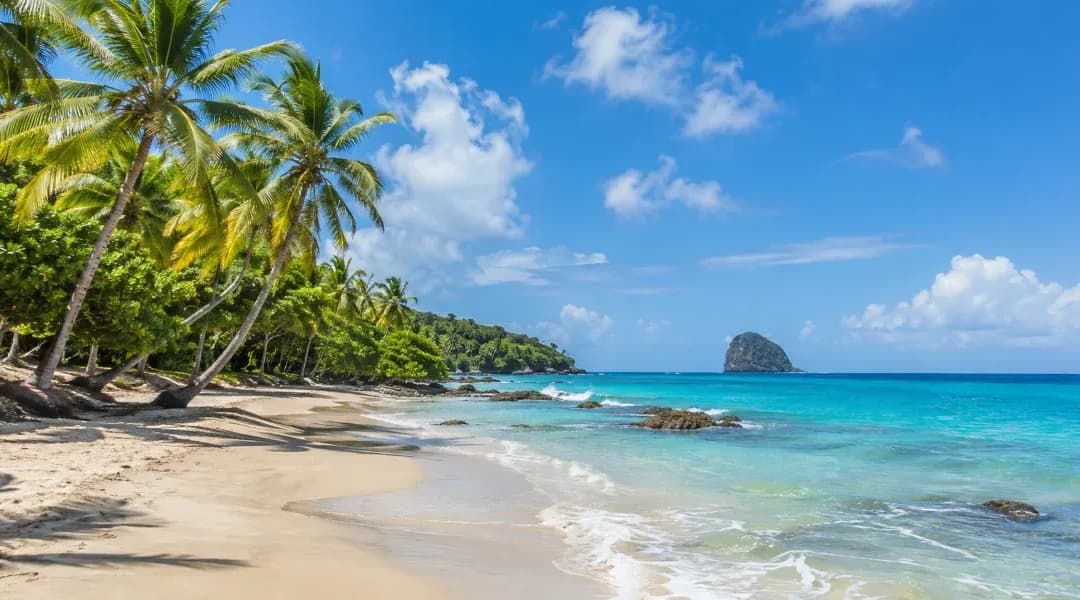
Here is our selection of beaches you can reach by car, from south to north, with what to know before you go. A rule of thumb: the Atlantic coast, to the east, is the roughest, as the swell usually comes from the east; the Caribbean coast, to the west, is often calmer, with exceptions flagged below.
The south
- Grande Anse des Salines (Sainte-Anne) — over a kilometre of white sand, 5 km south of the village. Very busy, especially at weekends; rescue teams regularly intervene there, so swim with care (see Sainte-Anne by car);
- Pointe Marin (Sainte-Anne) — calm water, ideal with children, very busy at weekends, with snack bars and water-sports clubs;
- Anse Michel and Cap Chevalier (Sainte-Anne, Atlantic coast) — shallow water, a windsurfing and kitesurfing spot; Îlet Chevalier, sheltered by a reef, is reached by boat;
- Anse Figuier (Rivière-Pilote) — calm water and lovely sea beds: bring a mask. Very busy, and no lifeguards;
- Grande Anse du Diamant — about 3 km of sand facing Diamond Rock, but a strong swell and current: swimming there is dangerous (see Le Diamant by car).
Les Anses-d'Arlet and Les Trois-Îlets
- Grande Anse d'Arlet — a bay facing due west, for swimming and snorkelling; turtles are seen there; lively at weekends (see Les Anses-d'Arlet by car);
- Anse Dufour — green turtles graze the seagrass in the middle of the bay: stay about 5 metres away, don't touch or chase them;
- Anse Noire — the only black-sand beach in the south, about a hundred metres from Anse Dufour, down a flight of 130 steps;
- Anse Mitan, Anse à l'Âne and Pointe du Bout (Les Trois-Îlets) — white sand, hotels, restaurants, a marina and water sports; from Anse Mitan, ferries cross to Fort-de-France (see Les Trois-Îlets).
The northern Caribbean coast
- Anse Turin (Le Carbet) — a grey-sand beach; the painter Paul Gauguin stayed in Le Carbet in 1887;
- Anse Céron (Le Prêcheur) — grey-black volcanic sand, shade, facing Îlet la Perle, with tables and showers;
- Anse Couleuvre (Le Prêcheur) — two wild beaches in a marine reserve, but a strong current makes swimming dangerous. The car park has about ten spaces and access is tricky for large vehicles: come early (see the north by car).
From north of Le Carbet to Grand'Rivière, as in Le Diamant, rescue teams regularly intervene: on this coast too, swim with care.
The Caravelle peninsula (Atlantic coast)
- Tartane beach — calm, shallow water, suitable for children, with fishing boats, showers and toilets (see the Atlantic coast);
- Anse l'Étang — a fairly rough sea, but a cove sheltered by shallows; a surfing spot (see La Trinité and Tartane).
Before you go
- Swimming — follow flags and signs; temporary bans are common (water quality, jellyfish). The Œil Bleu, in Sainte-Anne, is strictly off-limits for swimming;
- Manchineel — this highly toxic tree often grows along beaches: don't shelter under it, especially in the rain;
- Sargassum — check Météo-France's bulletin; with a car, switch beaches (see best time to visit);
- Parking — at the busiest beaches, arrive early at weekends; a small car is easier to park.
Frequently asked questions
Where is Les Salines beach?
In Sainte-Anne, 5 km south of the village, 10 to 15 minutes by car: over a kilometre of white sand. Come early at weekends, and swim with care.
Where can I see turtles in Martinique?
At Anse Dufour and Grande Anse d'Arlet, in Les Anses-d'Arlet. Stay about 5 metres away, without touching or chasing them.
Which beaches are unsafe for swimming?
Grande Anse du Diamant and Anse Couleuvre have strong currents: swimming there is dangerous. The Œil Bleu, in Sainte-Anne, is off-limits. Everywhere, follow flags and signs.
Where can I swim with children?
In the calm waters of Pointe Marin, in Sainte-Anne, and Tartane beach, on the Caravelle peninsula.