
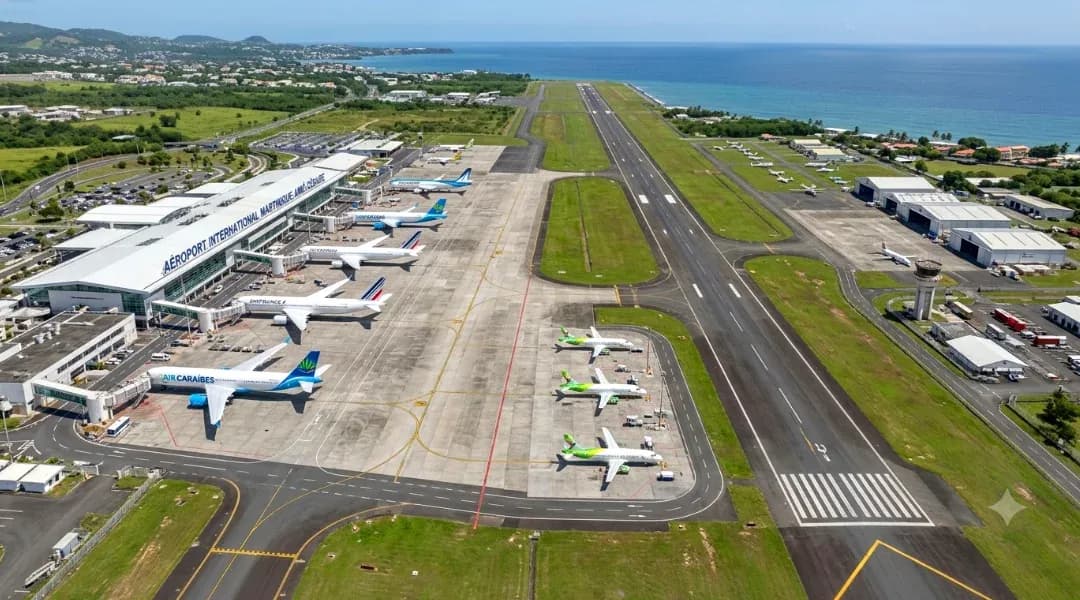
Martinique is not just "in the Caribbean": it is France — a French overseas department in the European Union, with French road rules, the euro and metric units. For a visitor from the United States or Canada, that changes a few things about renting and driving a car, and makes others easier than you might expect: you drive on the right, as at home, there are no toll roads, and the island is only about 70 km (45 miles) from north to south. Here is what we, a local rental company based in Le Lamentin next to the airport, explain to our North American customers.
Can I drive in Martinique with a US or Canadian licence?
Yes. Spar’Car accepts US and Canadian licences for tourist rentals: bring the original card, held for at least 12 months. We rent from age 18 with one year of licence; the standard conditions are 23 years of age and 3 years of licence, with a young-driver surcharge below that.
The official French rule for a short stay (Sécurité routière and service-public.fr) is that a licence issued outside the European Union must be valid and either written in French or accompanied by an official French translation or an International Driving Permit (IDP). A Québec licence is already in French and needs nothing more. US drivers and Canadians from other provinces can get an IDP before leaving, from AAA in the United States or CAA in Canada: it is a translation booklet, valid only together with your licence, and it keeps a roadside check simple. The IDP alone never allows you to drive — always carry your original licence.
The deposit: a credit card, not a debit card
Every rental carries a security deposit, returned after the car comes back in good condition. Two ways to give it: a pre-authorisation on a credit card in the main driver's name (Visa, Mastercard or American Express — debit cards are not accepted for the deposit, even with a Visa or Mastercard logo), or Swikly, an online deposit service that doesn't block your card limit, for a service fee (Swikly doesn't take American Express). The amount depends on the car category and the pack you choose; it is shown as soon as you book, before any payment, and released after the return — your bank sets how fast the hold disappears. Details on our deposit and excess page.
Insurance, excess and the "CDW" question
In France, third-party liability insurance is included in every rental by law: injuries and damage you cause to others are covered. Damage to the rental car itself is where the vocabulary differs. What a US rental desk calls the deductible, covered by a Collision Damage Waiver (CDW) or Loss Damage Waiver, is here the excess (franchise in French): the maximum you pay if the car is damaged or stolen. Two packs offered at booking reduce it — Petite Carrosserie (reduced excess) and Tout Compris (excess brought to zero, reduced deposit and the flexible-cancellation option, for drivers aged 23 and over with 3 years of licence). Some damage stays yours whatever the pack: tyres and rims, glass, wrong fuel, the interior, a driver not named in the agreement, driving under the influence (article 7.3 of our terms).
Many US and Canadian credit cards advertise rental car coverage. Whether yours applies in Martinique, to which vehicles, and what it reimburses is a question for your card issuer: ask before you travel and bring the written confirmation. We can't assess it for you, and choosing a pack with us is independent of it.
Automatic or manual? Book the automatic early
Most rental cars on the island are manual: automatics are the scarcest category and the first to sell out in high season (mid-December to mid-April, plus July and August). If you don't drive a manual, reserve an automatic as soon as your dates are set. Martinique's roads are hilly and winding rather than fast: an automatic, or an SUV, simply makes the climbs more comfortable. No road requires a 4x4.
On the road: right-hand driving, km/h, roundabouts, no tolls
- You drive on the right and overtake on the left, as in the US and Canada.
- Speeds and distances are in kilometres: 50 km/h (31 mph) in built-up areas, 80 km/h (50 mph) on two-way roads without a central divider, lower when it rains; on the A1 motorway and expressways, follow the signs. One mile is about 1.6 km.
- No toll roads: the only motorway, the A1, links the airport to Fort-de-France free of charge over about 7 km.
- Roundabouts are everywhere: slow down, give way to traffic already in the circle unless signs say otherwise, and signal when you exit.
- Alcohol: the limit is 0.5 g/L of blood (0.2 g/L for probationary licences), lower than the 0.08 % limit common in North America.
- Phone: holding a phone while driving is banned, and so are earpieces and headphones (€135 and 3 points); only the car's built-in hands-free system is allowed.
- Children under 10 must travel in an approved child seat or booster suited to their size, in the back: add a child seat or booster to your booking and it will be fitted in the car.
- Seat belts are compulsory front and back; speed cameras and roadside checks are frequent.
- Rain: showers are heavy from July to October and the road gets slippery — slow down. Night falls around 6 pm all year.
- Emergency numbers: 112 (European emergency number), 15 medical, 17 police, 18 fire.
More on the roads, the traffic and what to do after an accident in our guide to driving in Martinique.
Fuel, euros and payments
- Fuel is sold by the litre, priced in euros, at a maximum price set each month by the prefect of Martinique, which is what most stations charge. Unleaded is "sans plomb" (SP95 or SP98), diesel is "gazole". The car is handed over with a full tank: return it full, or fuel plus a service charge are billed (article 6 of our terms).
- The currency is the euro. The rental is paid online by card when you book — in full, or a 30 % deposit with the balance before pick-up — and by card on the spot. Dollars are not accepted. Most North American cards work; ask your bank about foreign transaction fees, and if a terminal offers to charge you in dollars, choose euros.
- Tipping is not expected at a car hand-over.
Practical: time zone, electricity, phone, passport, flights
- Time zone: Martinique is on UTC−4 all year, with no daylight saving. In winter it is one hour ahead of New York, Toronto and Miami (Eastern Standard Time); in summer, the same time as Eastern Daylight Time.
- Electricity: 220–230 V, 50 Hz, French type E sockets with two round pins. Bring a plug adapter, and check the voltage of any appliance that doesn't accept 220 V (most phone and laptop chargers do).
- Phone: the country code is +596. Check your carrier's roaming options for Martinique — it is often listed under France or the Caribbean.
- Passport: US and Canadian citizens enter with a valid passport; no visa is needed for a tourist stay of up to 90 days (check the France-Visas website for your situation).
- Flights: Martinique Aimé Césaire International Airport (FDF) in Le Lamentin has seasonal direct flights from North America — see the airport's airline list for the current season — and year-round connections through Paris and the Caribbean. Your car waits at the airport at your flight time.
Where your car is waiting
Three hand-over points, chosen when you book: Martinique Aimé Césaire Airport (FDF), at your flight time — no fee from 7 am to 6:30 pm, late-arrival fee in the evening and at night; our Le Lamentin agency, 350 Chemin Sarrault, open every day from 8 am to 9 pm; and the Fort-de-France cruise port, with a surcharge shown at booking. We don't bring cars to hotels or villas. Mileage is unlimited, the car is recent and air-conditioned, and the team answers seven days a week on +596 696 61 70 70, in English. For the capital itself, see car rental in Fort-de-France.
Frequently asked questions
Do I need an International Driving Permit to rent a car in Martinique?
For the rental itself, no: we accept a valid US or Canadian licence held for at least 12 months. For driving legally in France during a short stay, the official rule asks for a licence in French, an official translation or an International Driving Permit: a Québec licence qualifies as is; other drivers are advised to carry an IDP (AAA or CAA), together with the original licence.
Can I use a debit card for the deposit?
No. The deposit needs a credit card in the main driver's name (Visa, Mastercard or American Express), or Swikly, an online deposit service with a service fee that doesn't block your card limit.
Does my credit card's rental insurance cover me in Martinique?
Only your card issuer can tell you whether its coverage applies in Martinique, to which vehicles and for what amounts. Ask before you travel and bring the written confirmation. Our packs that reduce the excess are independent of it.
Are automatic cars available?
Yes, in limited numbers: automatics are the island's scarcest category. Book early, especially from December to April and in July and August.
Which side of the road do you drive on in Martinique?
On the right, as in the United States and Canada. Speeds are posted in km/h and distances in kilometres.
Are there toll roads in Martinique?
No, none. The only motorway, the A1 between the airport and Fort-de-France, is free.
What time is it in Martinique compared with New York or Toronto?
Martinique keeps UTC−4 all year, without daylight saving: one hour ahead of Eastern Standard Time in winter, the same as Eastern Daylight Time in summer.
Can I pay in US or Canadian dollars?
No: payments are in euros, by card — online when you book (in full or a 30 % deposit) and on the spot. Most North American cards work; check your bank's foreign transaction fees.
Where do I collect the car when I land at FDF?
At the airport, at your flight time: our agent waits at the arrivals exit with the car — no fee from 7 am to 6:30 pm, late-arrival fee in the evening and at night. Give your flight number when you book; we follow the flight. Step by step on our airport car rental page.